Foot issues like bunions can have a drastic impact on your pace and ultimately on your daily schedule.
A bunion is defined as a bony bump that develops on the joint at the base of your big toe. This type of foot deformity consists of both bone and soft tissue.
It occurs when the big toe pushes against the toe next to it, forcing misalignment of the joint.
While bunions are common on the joints of big toes, smaller ones can develop on your little toes.
In addition to the bump, other symptoms of a bunion include inflamed skin on the side of your big toe, thick skin on the underside of your big toe, calluses on your second toe, persistent foot pain and difficulty moving your big toe.
Wearing poorly fitting shoes is the most common cause of bunions. They can also be caused due to genetics, where a faulty foot structure is inherited. Some medical conditions that can contribute to this kind of foot deformity are flat feet, excessively flexible ligaments and an abnormal bone structure.
There are several treatment options available for bunions, including surgery. The goal of surgery is to relieve pain and improve functioning. But it is important to know that after surgery, you may have to temporarily wear a surgical shoe or a cast as well as keep all weight off the foot for sometime.
Surgery is an expensive procedure. Hence, it may be wise to seek a second opinion before making a final decision.
If your problem is not too severe and you are looking for less invasive and natural treatment options then you can try some easy-to-follow remedies that help reduce the symptoms as well as improve the condition of your foot and slow a bunion’s progression.
Here are the top 10 ways to treat bunions without surgery.
1. Cold Compresses
To reduce pain and swelling, cold compresses are the best treatment. The cold temperature provides relief by lending a numbing effect on the nerve endings.
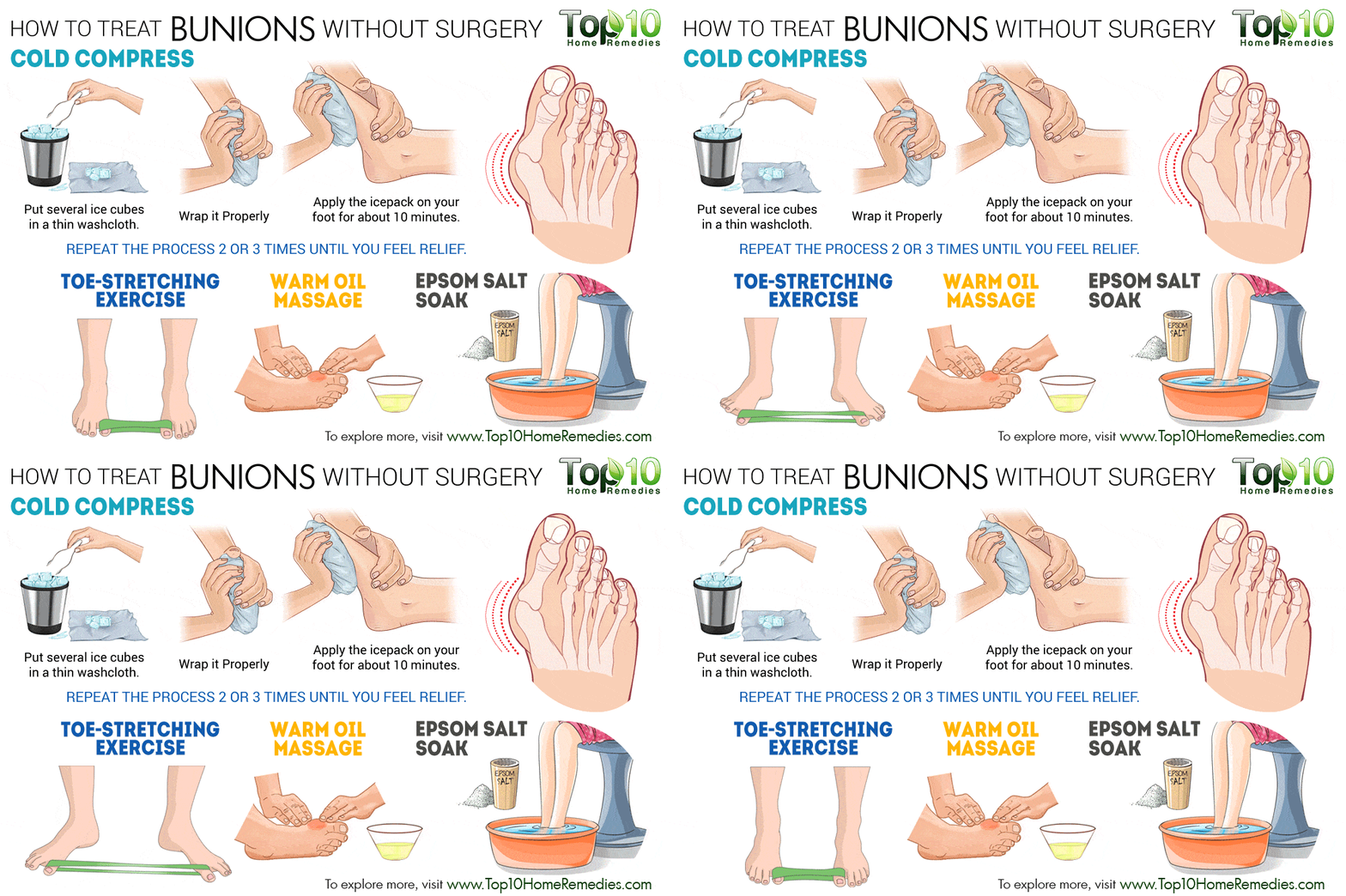
- Put several ice cubes in a thin washcloth and wrap it properly.
- Apply the ice pack on your foot for about 10 minutes.
- Remove the ice pack for 5 minutes.
- Repeat the process 2 or 3 times until you feel relief.
- Use this simple remedy a few times a day.
Note: Do not use ice directly on the skin to avoid ice burns.
2. Toe-Stretching Exercises
Any exercise that helps strengthen the abductor hallucis, a muscle in your foot responsible for the flexibility of your big toe, is effective at reducing the discomforts of bunions.
Stretching exercises for toes will help keep them flexible and mobile. They will also improve circulation, red blood cell activity and bone realignment. However, exercise will not correct the position of a deformed toe.
- Place an elastic band around the big toes on each foot.
- Slowly turn your feet outward until you feel the stretch on the big toes.
- Hold this position for 1 minute.
- Relax for 1 minute, and repeat again.
- Do this exercise for 15 minutes, 2 or 3 times daily.
[youtube:https://www.youtube.com/watch?v=GncdLDamLMI]
3. Warm Oil Massage
Massaging the affected area with some warm oil is another effective way to treat the discomforts of bunions. Massage improves blood circulation, which helps reduce the severe pain as well as inflammation.
It also reduces the pressure between the toes and the risk of developing corns and calluses.
- Warm some castor, olive or coconut oil in the microwave.
- Dab the warm oil on the affected area.
- Using your fingers, do deep-friction massage for 10 minutes.
- Repeat 2 or 3 times daily.
4. Epsom Salt Soak
The high amount of magnesium sulfate in Epsom salt can help get rid of the inflammation and pain brought about by the bunion.
- Pour a few tablespoons of Epsom salt in a foot tub that is big enough to cover your foot up to your ankle.
- Fill the tub with lukewarm water.
- Soak your tired feet in it for 15 to 20 minutes.
- Use this remedy 2 or 3 times a week.
If you do not have Epsom salt, even a warm water soak will help.
5. Chamomile
Chamomile is one of the best herbal remedies that provide relief from bunion issues. Its anti-inflammatory nature helps reduce the swelling and inflammation as well as reduce the pain.
- Brew a cup of chamomile tea and drink it 2 or 3 times a day.
- Also, apply the used, warm chamomile teabags directly on your bunions for 10 minutes, 2 or 3 times daily.
- Alternatively, mix 1 tablespoon of dried chamomile with enough water to form a paste. Apply this paste on your bunions. Leave it on for 15 minutes, then rinse it off with water. Follow this remedy twice a day.
6. Calendula
Like chamomile, calendula is another herb rich in anti-inflammatory properties that can help reduce the discomforts caused by bunions, such as pain and swelling. Plus, it can reduce the risk of developing corns and calluses on the affected area.
- Apply over-the-counter calendula ointment on your bunions 2 or 3 times daily.
- Alternatively, crush some fresh calendula leaves to extract the juice. Apply the juice on the affected area and allow it to dry on its own. Repeat 2 or 3 times daily.
7. Turmeric
- Dissolve 1 teaspoon of turmeric in a glass of lukewarm water. Drink it twice daily to ease inflammation.
- Also, mix a little olive oil and ½ teaspoon of turmeric powder to form a paste. Apply it directly on your bunion 2 or 3 times daily for several days.
- Alternatively, you can take curcumin capsules, after consulting your doctor for proper dosage.
8. Cayenne Pepper
Cayenne pepper is effective in relieving the pain caused by bunions. It contains the compound capsaicin that has anti-inflammatory properties that help get rid of the pain and discomfort of bunions.
- Apply a thin layer of petroleum jelly on the affected area and put cayenne pepper powder over it. Leave it on for a few minutes, then gently press on the area with a piece of cloth.
- Alternatively, buy an ointment containing capsaicin and apply it directly on your bunion 2 or 3 times a day.
9. Acupuncture
While acupuncture isn’t a way to get rid of bunions forever, it can ease the pain on the side of your foot.
In acupuncture, thin needles are used locally on and around the bunion, along with points that can address a weak spleen, an underlying cause of bunions.
It is best to have acupuncture done by an expert who specializes in it. It may take few sessions of acupuncture to reduce the pain and improve the mobility of your foot.
10. Wear the Right Shoes
When suffering from a bunion, check your footwear. Improper footwear not only puts you at a higher risk of foot problems, it can even aggravate the symptoms and delay the healing process.
- Look for shoes that have a wide, deep area for toes to avoid rubbing and putting pressure on the bunion.
- Any pair of shoes that you wear even for a few hours should have plenty of room around your toes and should conform to the shape of your foot.
- You can use padded shoe inserts to distribute pressure evenly when you move your feet.
- Avoid wearing high-heeled shoes with narrow, pointed toes as they can cause friction and abnormal movement of the toe joints.
- Do not wear tight-fitting socks or stockings.
Additional Tips
- Try using shoe inserts to avoid abnormal foot motion. Arch supports or orthotics prescribed by a physician are also very helpful.
- Using pads or cushions may help reduce the discomforts. However, avoid over-padding as it may increase pressure, leading to more pain.
- For mild to moderate bunions, walking barefoot can help a lot.
- Wear padded socks when you’re walking around the house.
- Avoid ballet dancing and other activities that require constrictive shoes.
- To curb pain and inflammation, include anti-inflammatory foods in your diet. Also, include protein as well as foods rich in vitamins A, B complex, C and E in your diet.
https://www.top10homeremedies.com/how-to/treat-bunions-without-surgery.html


 觀察大拇趾下方第一蹠骨與趾骨的連線交角(上圖兩黑線夾角):


 做縮足時,會發現腳的重心調整後,足底會自然地輕輕出力,拉起內側的足弓,讓大拇趾與第二腳趾分開。抓到感覺後,請做 10 下弓箭步蹲,過程中維持縮足的動作,不能被「打回原形」唷!
 縮足就跟平時需要維持的正確姿勢一樣,只要養成習慣,應用到走路、站立等日常生活中,拇趾外翻就能有效地被控制。是不是很神奇呢?快來試試上頭三招放鬆術吧!